
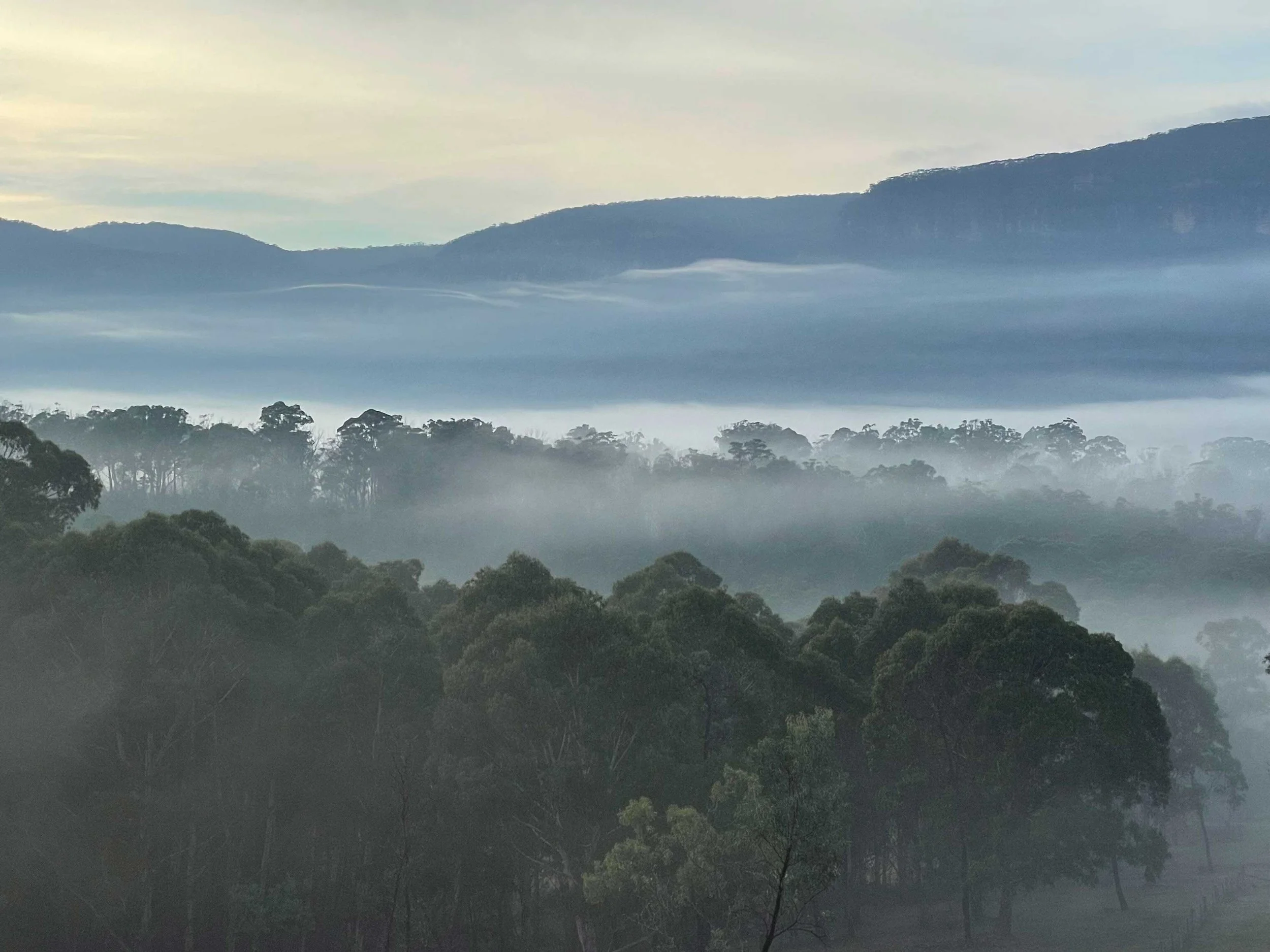
Megalong Valley: A Brief History.
written by Rod Hill.
Image by Oliver Michell
Megalong Valley, located 120 kilometres west of Sydney in the UNESCO listed World Heritage Blue Mountains National Park, is part of the ancestral home of Australia’s Gundungurra people.
Although ‘of the mountains’, Megalong Valley is regarded as a place apart, with a single road accessing the valley, in and out, it is clearly distinguished from the series of settlements located on the ridge of the Blue Mountains.
Origins.
Megalong’s first European settlers arrived long before those at most of the ridge-top settlements, especially Katoomba, or its earlier iteration, The Crushers. It is agreed that the first white man to touch the valley floor was Thomas Jones, a collector of natural history specimens who, in 1818, explored the length of the Cox’s River from Hartley to its junction with the Warragamba.
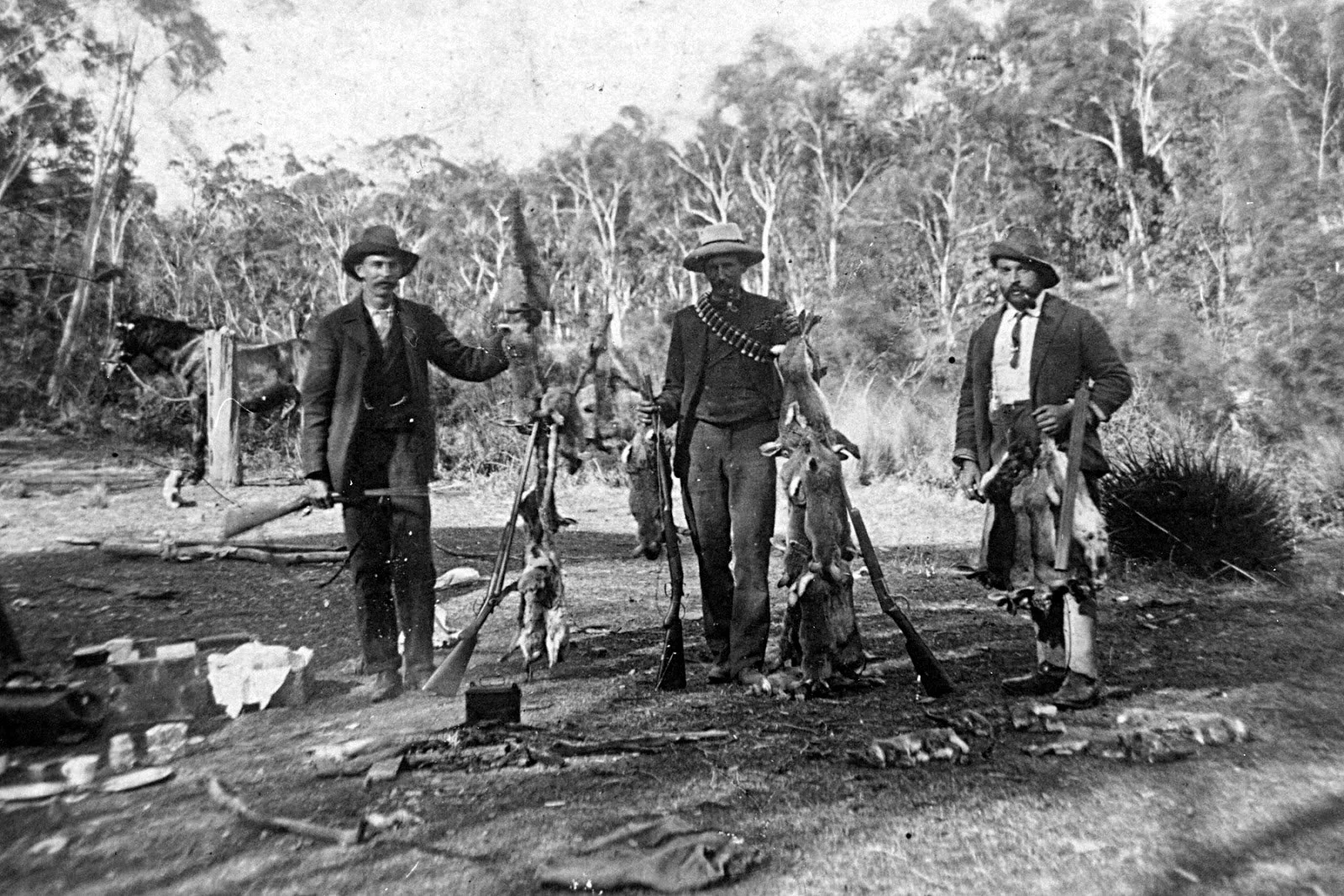
Rabbit Shooting in Megalong Valley, from Blue Mountains Local Studies Collection. (Blue Mountains City Library)
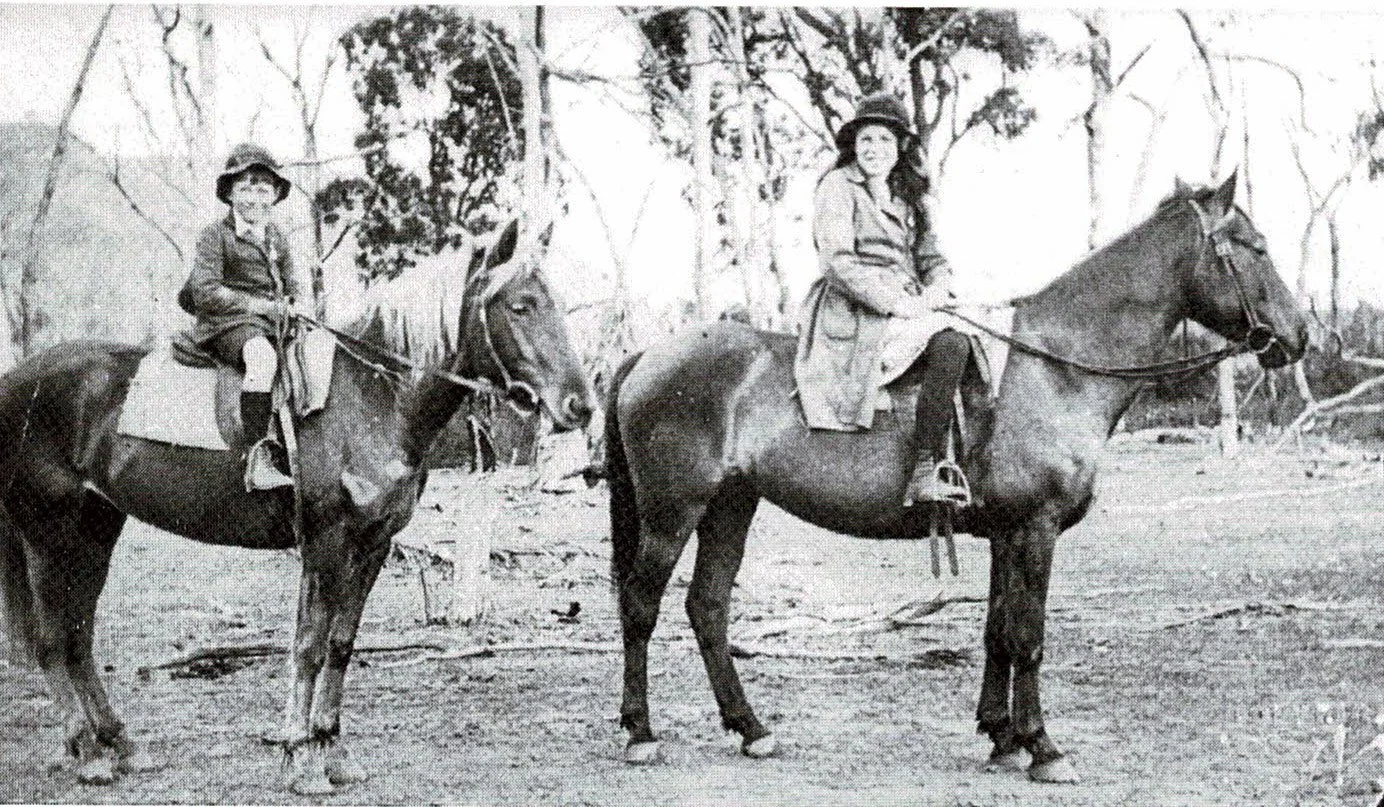
Bill and Margaret Ward returning from school 1918, photo by Harold Ward, from Historic Megalong Valley by Mary Shaw. (MVCLA)
Early Settlers.
The first land title formally registered in Megalong was the 4,000 acre property Kanimbla Station, of prominent Sydney solicitor James Norton in 1824, ultimately to expand to “over 10,000 acres” in Kanimbla and Megalong. It is very likely that squatters were in occupation of land before the Nortons registered their claim. These would be settlers moving cattle across from the adjacent Burragorang Valley.
Cattle had escaped captivity in the very earliest days of the colony and had long since settled into a wild existence in the area then named Cowpastures, south of Sydney. For settlers who later took up land in the Camden area the journey to a newly discovered, unoccupied valley was a inexpensive way to maintaining, and increasing, their herd. This route was closed off in the 1950s as the Warragamba Dam displaced Burragorang Valley - now Lake Burragorang.
The first survey in today’s Megalong took place in 1838 when WR Davidson noted “640 acres near the isolated mountain, applied for by EB Bolton”, with an attached sketch showing “Megalong Creek”, possibly where it joins the Cox’s River. This is probably the first reference to ‘Megalong’. Bolton immediately passed the land over to George Aspinall for 160 pounds, or 5 shillings an acre. This property came to be known as Megalong Station, stayed in that family for thirty years and eventually, in 1901, came in to the possession of the prominent Ward family.
Mrs Ann Ward arrived in the Valley two-years earlier, purchasing the property then known as, and still is, Euroka. The Ward family eventually owned about 6,000 acres in Megalong, which was used as a reserve for their principal property near Nyngan. Two early settlers were Patrick McAviney, who bought 100 acres in 1849 close to where Valley Farm is now situated, immediately below Medlow Bath; and GD Grant who purchased 40 acres near the Cox’s River in 1862. Another large land holder in these days was Henry Peckman.
Patrick McAviney, not reputed to be a warm person, came to a sticky end in 1873 when his wife Ann struck him several times with a tomahawk, with sufficient force to lay him down. Ann confessed: “I got disgusted with my husband for the cool way in which he treated me. I thought I would show him the way in which he ought to treat a wife”. Her deposition was witnessed by 24-years old solicitor Edmund Barton, later Australia’s first Prime Minister. Ann was subsequently sentenced to death, a sentence that was commuted to life imprisonment. She died of natural causes in Darlinghurst Gaol ten-years later. This is the only capital crime known to have been committed in an otherwise tranquil rural retreat.
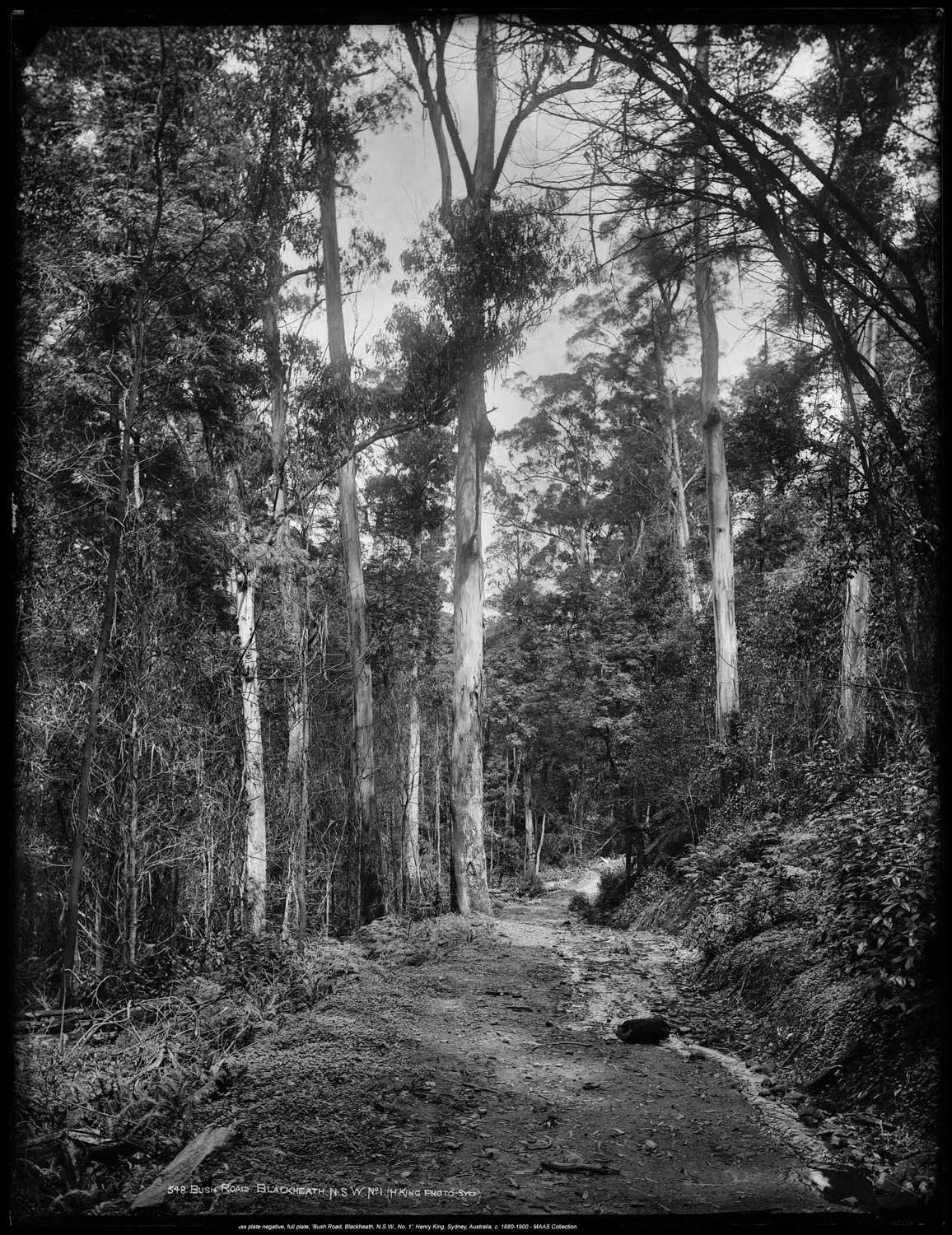
Bush Road, Blackheath, N.S.W., No. 1’, Henry King, Sydney, Australia, c. 1880-1900. (MAAS Collection)
Roads and Tourism.
The prominent Valley Farm property, 300 acres, was bought from John and Clara Axford by Sydney retailer Mark Foy in 1903. To this Foy added 200 acres purchased from Donald Boyd, and then another 60 acres. These were strategic purchases by Foy. In time he would connect a flying fox between Valley Farm and the soon to be completed Hydro Majestic retreat at Medlow Bath, carrying meat and farm produce for use in the Hydro, and returning scraps and waste for use on the farm. The Foy family passed the greater part of Valley Farm on to the present owners in 1954. In the early years of the century Mark Foy added the Megalong Racecourse to the property he had purchased in the valley.
By 1884, rail travel had generated a growing interest in Blue Mountains tourism. To facilitate this NSW Premier Alexander Stuart ordered work to be undertaken to create a horse track between Katoomba and Jenolan Caves. Starting at the Explorers’ Tree on Pulpit Hill, a team from Sydney completed the task in ten days, covering a distance of about 44ks. Trees were blazed along the way, and mile pegs set out. Parliament then granted 2,500 pounds to make a “six-foot track” along the path surveyed, with provision for it be permanently maintained by a team of two men working with a pick and shovel. An 1894 NSW Railways Tourist Guide described the track as 'steep in places, but the romantic beauty of the surroundings amply compensates for the roughness of the ground'.
Tourism operators were delighted, and a practical access to Megalong Valley from Katoomba, up on the ridge-line, had been created. Tourists leaving Katoomba could now arrive at their Jenolan destination in less than eight hours, and the Six Foot Track facilitated the growth of permanent settlement, mostly adjacent to the new track, as it wound its way to, and beyond, the Cox’s River. Settlers as Megalong parted the nineteenth century, included the Boyd, Tolhurst, Duff, Duncan, Carlon, Kirby, Grady, Ward and Gracey families.
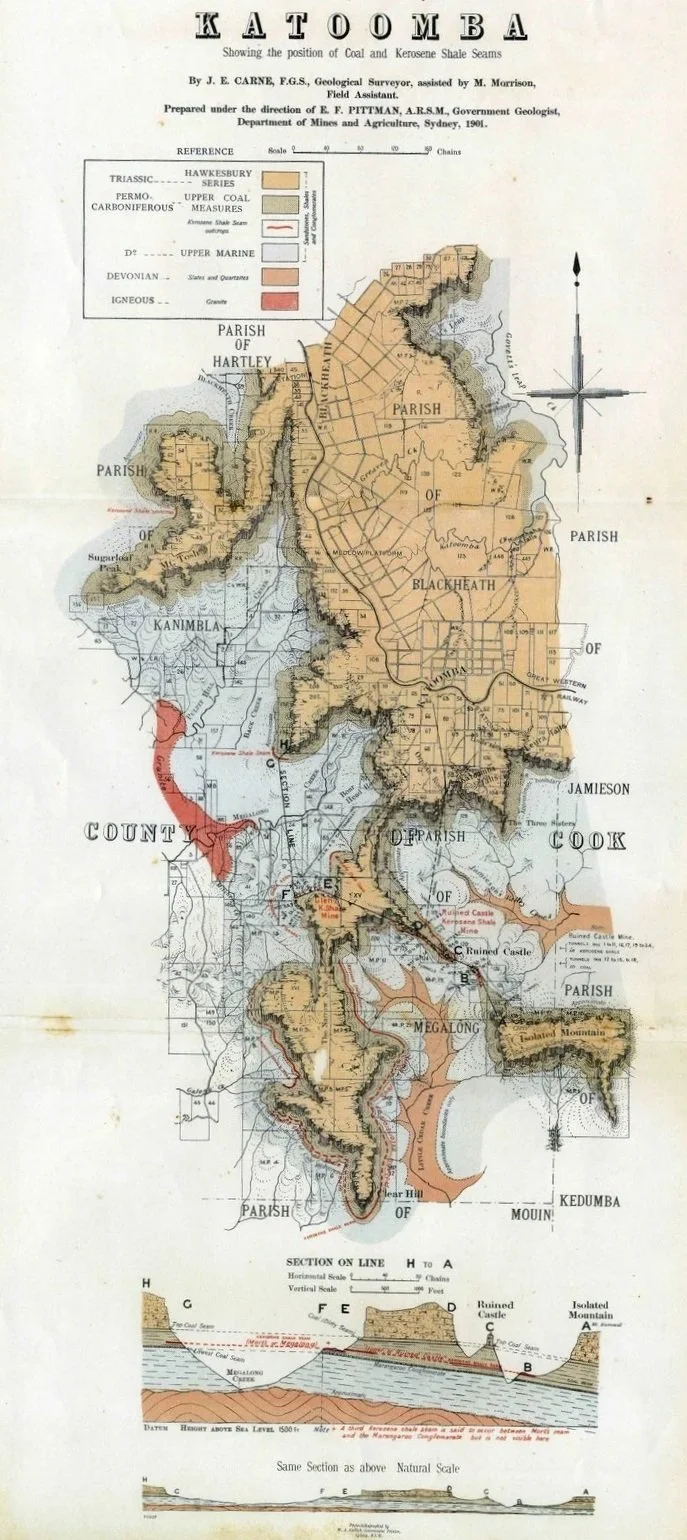
1901 Geological Map, From Blue Mountains Local Studies. (Blue Mountains City Library)
Mining and a Lost Village.
Oil shale, an ore then used in the production of kerosine, was discovered in Megalong in 1870, and by 1885 John Britty North and his Australian Kerosine and Oil Co Ltd began mining the resource. A significant initiative was the construction of a tunnel under Narrow Neck, through which shale was moved from Megalong to the Jamison Valley; and from the Jamison ore was moved, by rail, from both valleys up to the railhead. 1893 was the great production year at the Glen Shale Mine, with 90 miners on site. By 1895 the number of miners had reduced to five or six. The increasing use of coal-generated electricity, for industry and domestic purposes, meant that by 1904 the mining of oil shale was no longer viable. The mine ceased production. By that time the return per ton on oil shale was only 20 per cent the value of what it had been in 1870.
The end of mining also spelt the end of the Nellies Glen’s ‘Megalong Village’. At its peak, the 1890s, the village comprised a 13-room hotel, a butcher’s shop, a bakery, a general store and a public hall, servicing as many as forty families. A room at the hotel was always reserved for Father McGough, who travelled from Katoomba each Sunday to visit his small flock. The hotel and village flourished for almost a decade, but in 1904 all the village buildings were demolished and reusable materials relocated to Katoomba.
The loss of the village meant the loss of convenient access for Valley residents to shop for weekly provisions. Prior to the village residents would travel to Little Hartley or Hartley Village, still the only means of wheeled access to Megalong, to shop for supplies, or (since 1884) by foot or horse via the Six Foot Track to Katoomba. Provisioning was supplemented by frequent visits to the Valley of travelling Indian hawkers, still common throughout rural New South Wales, who could be relied on for needle and thread, soap and a thousand household essentials.
Mining and miners were the justification for a mail service being introduced into Megalong in 1892; the service continued long after the miners had departed, with a Megalong Post Office operating originally out of the village store, then various houses and properties until the service was discontinued in July 1967. The last post office was attached since 1948 to John Kirby’s home, by which time twenty-six subscribers were connected to the Megalong automatic telephone exchange.
In 1897 wheeled vehicular access between the valley and Blackheath was finally realised. This not only facilitated ease of access to shopping options in that village but, with the mining industry approaching exhaustion, and miners departing, some in Megalong turned to timber as a source of income. Facilitated by now convenient access to Blackheath, the valley became a source of quality product for processing in timber mills, and lower grades to be used for fencing and firewood. With timber as the principal source for domestic fuel and heating, settlements on the ridge provided quite a lucrative income for some of these early settlers - and provided an income to enable the development of their own properties. Until the summer of 1904.
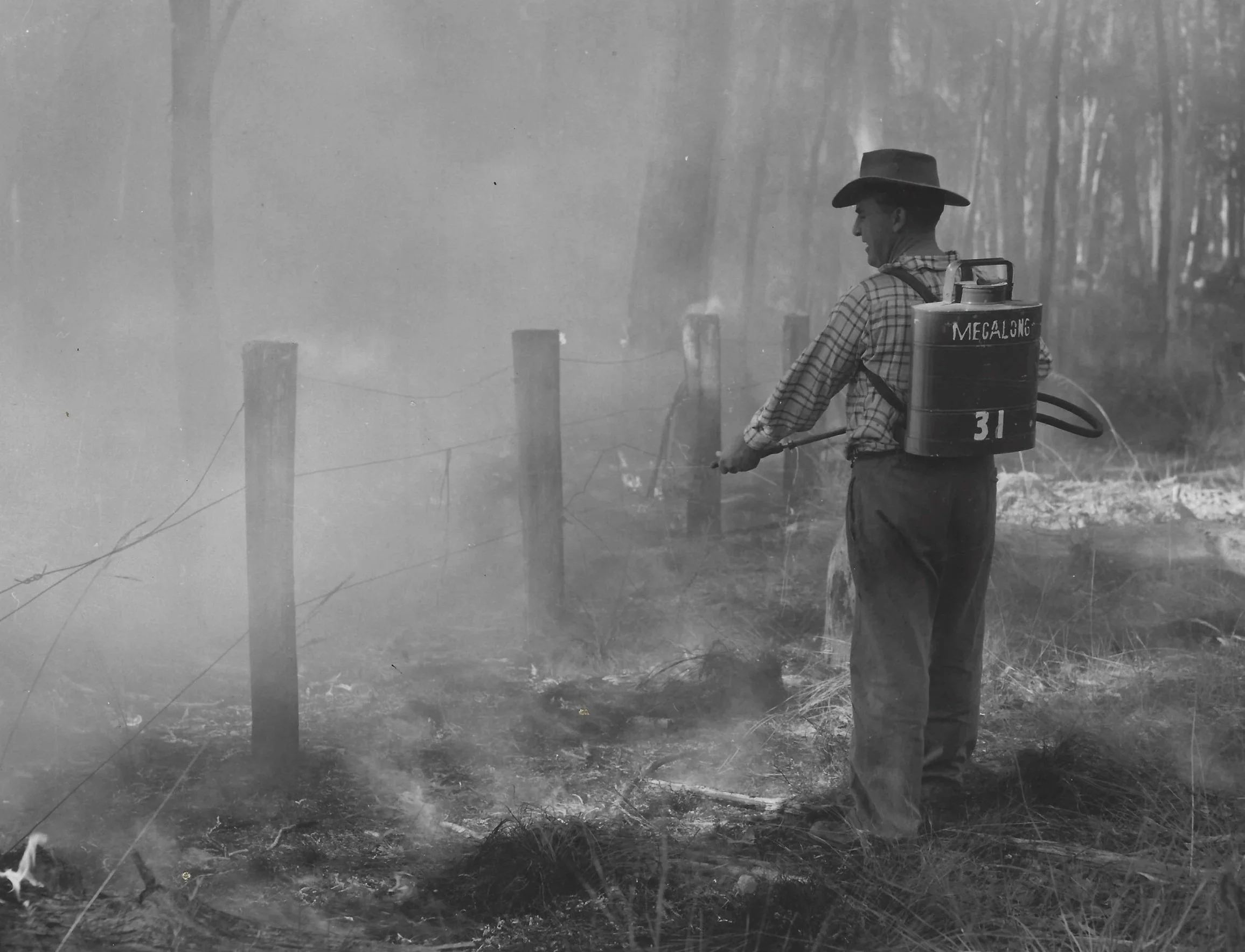
Keith Duncan, a foundation Captain of the Megalong RFS. (Megalong RFS, Simon Anderson)
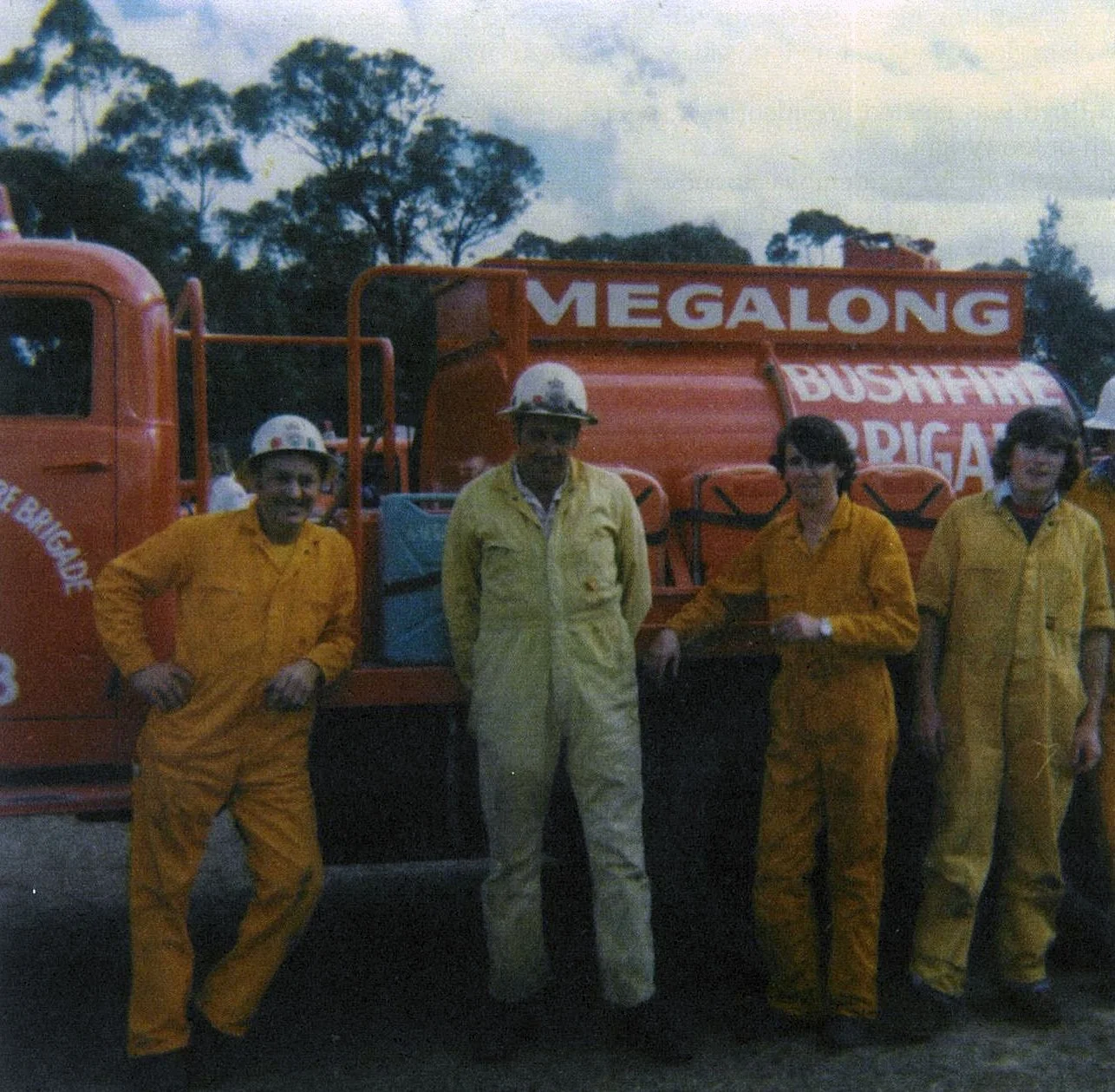
A snapshot from 1976, courtesy of Megalong RFS. (Megalong RFS, Simon Anderson)
The Bushfire of 1904.
On the heels of Megalong village ceasing to be, the Valley suffered its first Big Bushfire. The early years of the twentieth-century were drought years throughout NSW. Massive heat had been generated across the State during the last days of 1904, with one claim on New Years Eve that the thermometer reached 53 degrees celsius in Katoomba. Fanned by winds coming from three directions the fire “blew with fury, rousing the flames and sending them leaping across ridge and valley … within a day all labours and achievements of seventy years (in Megalong) were swept into oblivion … Homes, stock and fences disappeared.” Incredibly, there was no loss of life, although George Tolhurst, from Galong Creek, is credited with saving the lives of seven women and children. George, with brother Fred, then took refuge in the creek to watch their own home burn.
On 13 January the Katoomba Mountaineer reported: “It was impossible to exaggerate the absolute desolation right from Nellie’s Glen to Kanimbla. The soil is as bear as the road; no grass anywhere visible, only a forest of blackened stumps with here and there the ruins of a homestead”. Reflecting forty-years on, Jack Duncan stated that “for many years prior to it the valley was fertile and ideal for grazing, with tall timbers and lush grass: but after the fire the rabbits came in great numbers”. Serious bushfires have since reappeared at regular intervals, including 1926, 1939, 1957, 1968, 1980 and 2019.
With Megalong vulnerable to the ever-present threat of fire farmers organised themselves into informal fire-fighting units. It is thought Tom Ward, Jack Duncan and Jack Kirby were prominent at these earliest times. In October 1952 a meeting was convened at the schoolhouse to establish a Volunteer Fire Brigade on a formal basis. Locals organised a series of dances at Blackheath to generate funds for the purchase of necessary equipment. An equipment shed was built on Keith Duncan’s property, and by 1954 an ex-army blitz truck had been purchased - fitted with a water tank, pump and hand equipment. Initial office bearers were Jack Kirby, Bill Abel and Ken Skeen.
Today the Megalong Valley Volunteer Bushfire Brigade has a modern, purpose-built fire shed, officially opened in 2004, with modern engines, communications and fire fighting equipment. Supported by every resident, the volunteers comprise the very best men and women in the Valley, and some from beyond, who freely give of their time and expertise to ensure our safety. The appalling fire season of 2019/20 put Megalong’s brigade to an absolute test, and demonstrated once again how our volunteers are qualified, prepared and able to confront the most exacting challenges.
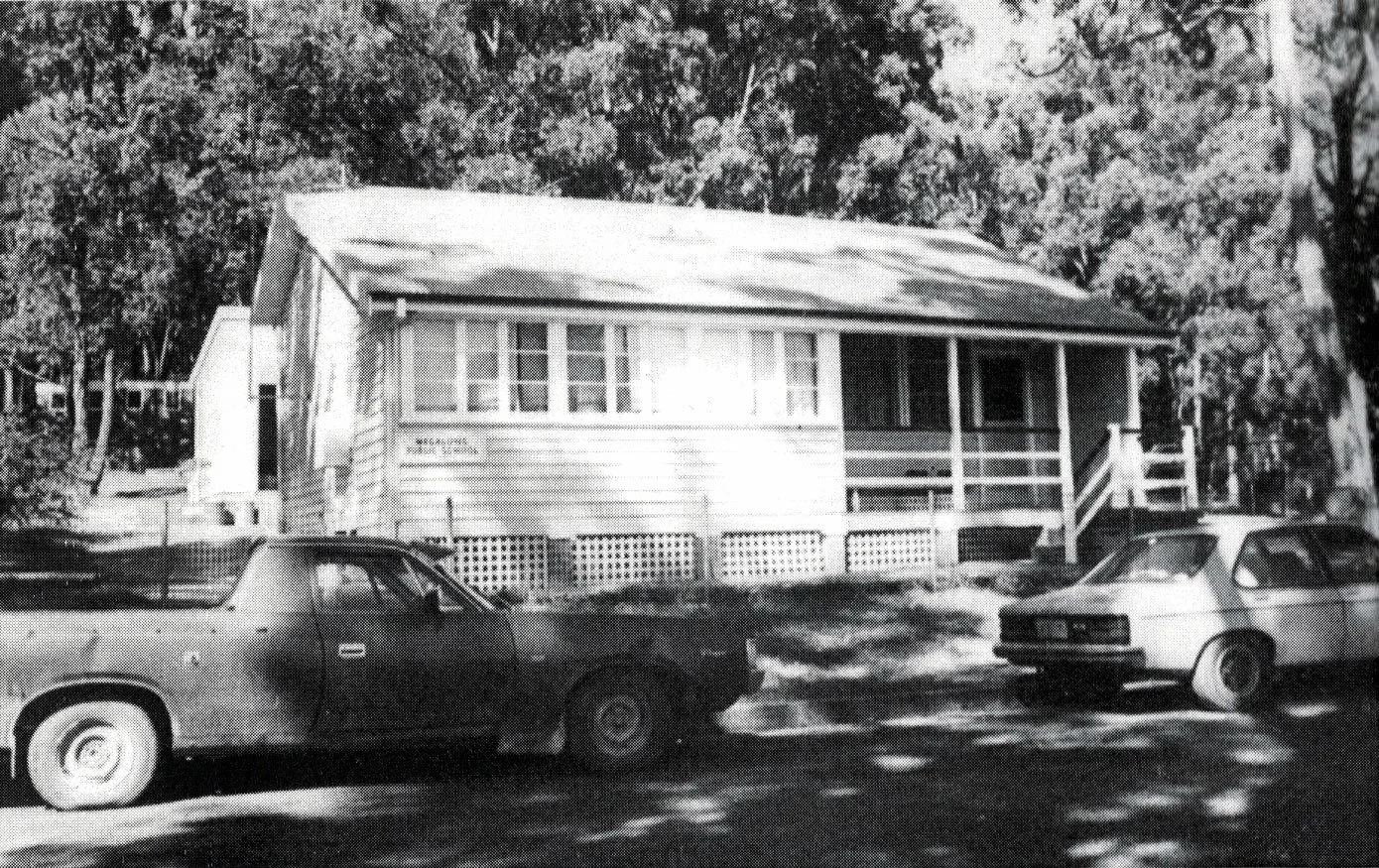
Megalong Public School in 1988, Photo by D. Walsh, from Historical Megalong Valley by Mary Shaw. (MVCLA)
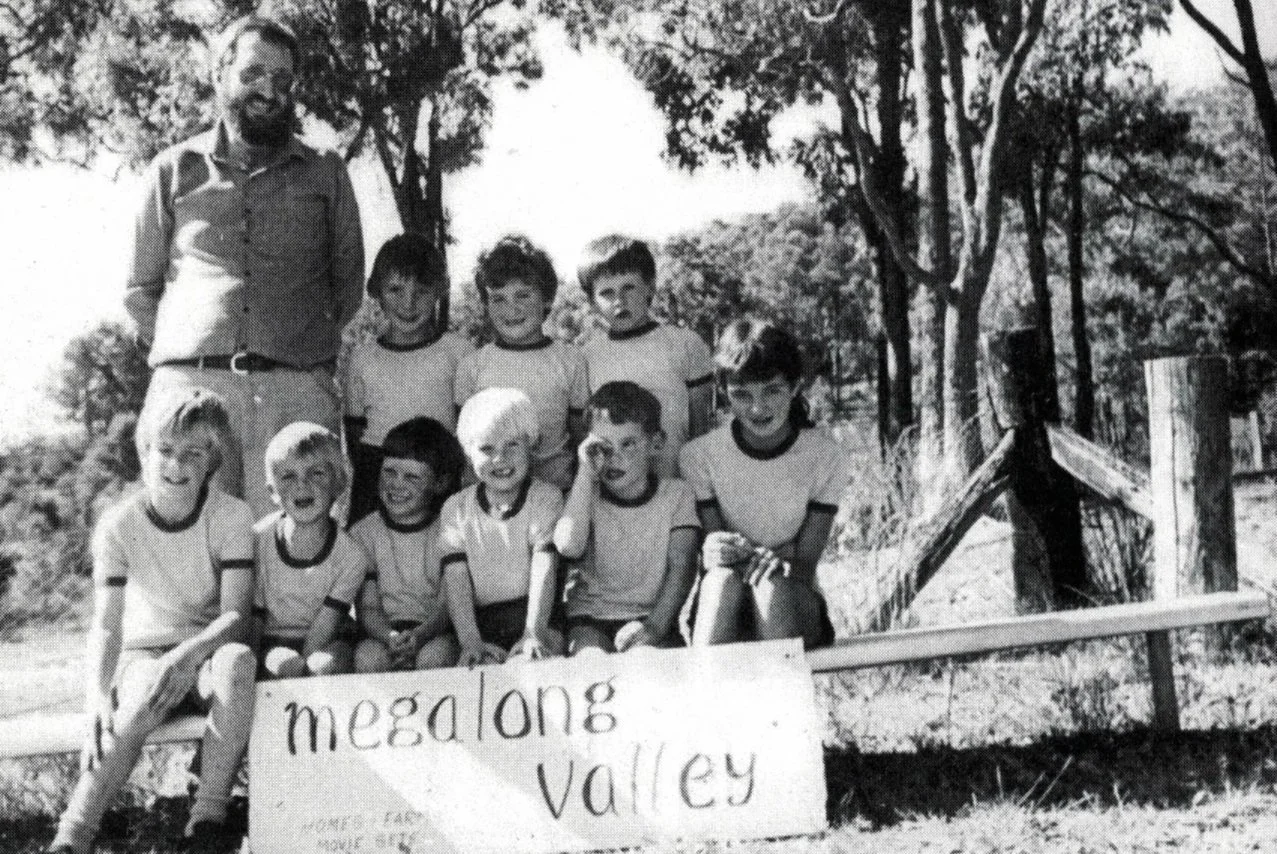
1988: Teacher-in-charge: Bob Logue. Back row left to right: John Barnett, Emily Boyd, Ben Greenhalgh. Front row: Ben Bowles, Gordon Barnett, Edward Walsh, Tim Bowles, Tom Walsh, Natasha Boyd. Photo by D. Walsh, from Historical Megalong Valley by Mary Shaw. (MVCLA)
The Megalong School.
1892 had seen a public school established in Megalong Valley - with something of a bang. Initially the first school, located on the property of John and Mary England near the junction of Nellies Glen and Megalong Roads, is purported to have catered for as many as seventy pupils. This reflected the number of miners, and the many families, associated with the Glen Shale Mine. As mining activity quickly dwindled by 1894 the school was relocated to Chaplowe, and nearer to the small settler population - with daily attendance down to 12 or so. By 1897 the school was back on the England’s property, and within three years the Department of Education erected a small purpose-built school on the property.
Megalong school survived the massive bushfires of 1904/05, with the sole loss of the boys water closet, but floods followed shortly after. (Megalong’s weather experience then was a precursor to that experienced 115 and more years later). In 1915 Megalong Public School was established on its present site - and it is thought that the existing school was physically relocated from England’s property to its new location. All was settled, learning and other activities continued apace, until disaster struck on 16th August 1937. Burning embers in the fireplace caused the school to be burnt to the ground. Little was saved.
After several years of temporary arrangements, it was May 1941 before a new building was available for occupation. Student numbers have varied since that time, with one or two significant peaks, and several troughs, but the school remains a critical part of the Valley’s infrastructure. And it was from this building, with its subsequent additions and improvements, that Megalong Public School celebrated its First 125 Years in March 2017.
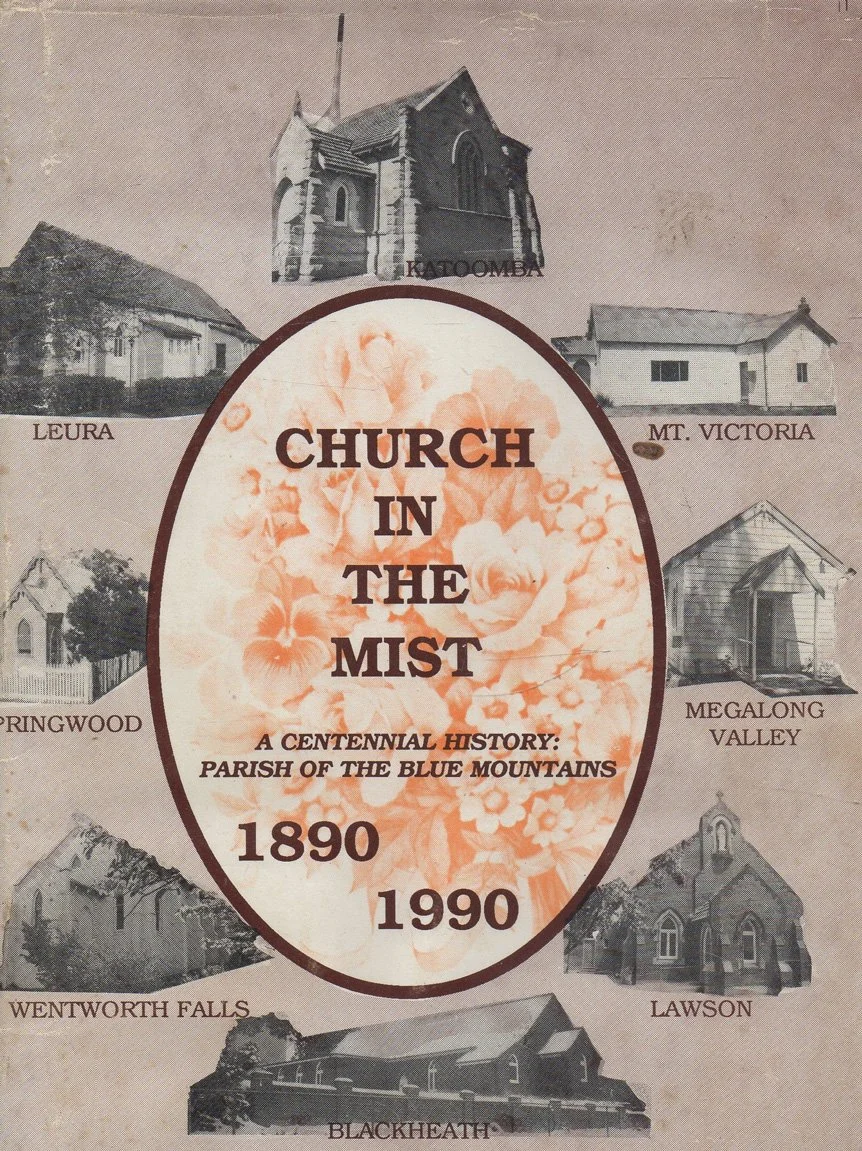
Cover of: Church in the Mist: A History of the Parish of the Blue Mountains A Centennial History: Parish of the Blue Mountains, 1890-1990 by Kevin Baker, 1990.
Megalong Worship.
Along with formal education, Christian worship arrived in Megalong Valley in the 1890s. The village hall was initially the location for Congregational services, followed by services in various homes until a church was built in 1923 on land donated by the Boyd family. Damaged by lightning in 1942, the church was replaced by the present building in 1943. A frequent visitor to the Valley at the turn of the century was young Douglas (later Sir Douglas) Mawson, a close friend of the second minister. He is said to have used Megalong and Burragorang as training grounds for his later Antarctic expeditions. St Joseph’s Catholic Church was built in 1908 and located adjacent to Megalong’s Cemetery. Accidentally burnt down, the church was re-built then relocated to its present site at the entrance to Euroka in 1952. Land for the church was donated by the Ward family.
Megalong on Screen.
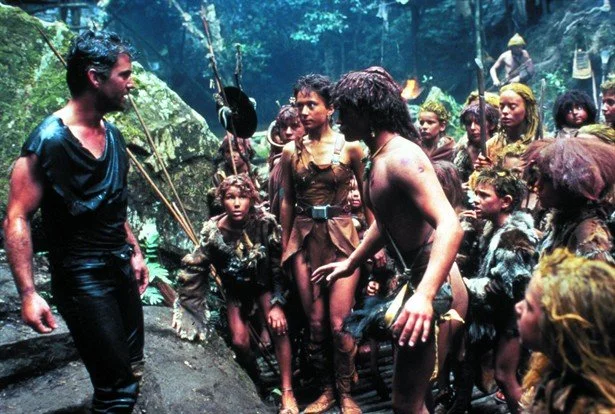
With spectacular backdrops and scenery, Megalong has been chosen several times as a location for movies and television. As early as 1920 cinema pioneer Raymond Longford filmed much of the very first On Our Selection in Megalong; this was followed in 1934 by the notorious When the Kellys Rode, the first depiction of the Kelly Gang with sound. Critical response was “unenthusiastic”, and the film returned 750 pounds at the box office.
Other films have followed, as recently as Stealth - “a military science action film” - in 2005. The BBC/ABC co-production Ben Hall television series was filmed in Megalong in the 1970s - with John Hollingdale responsible for ‘wrangling’ all the farm animals used on set. Mermaid’s Cave and Coachwood Glen have also served as notable scenic backdrops to large productions Mad Max: Beyond The Thunderdome and Kingdom of the Planet of the Apes (2024) respectively.
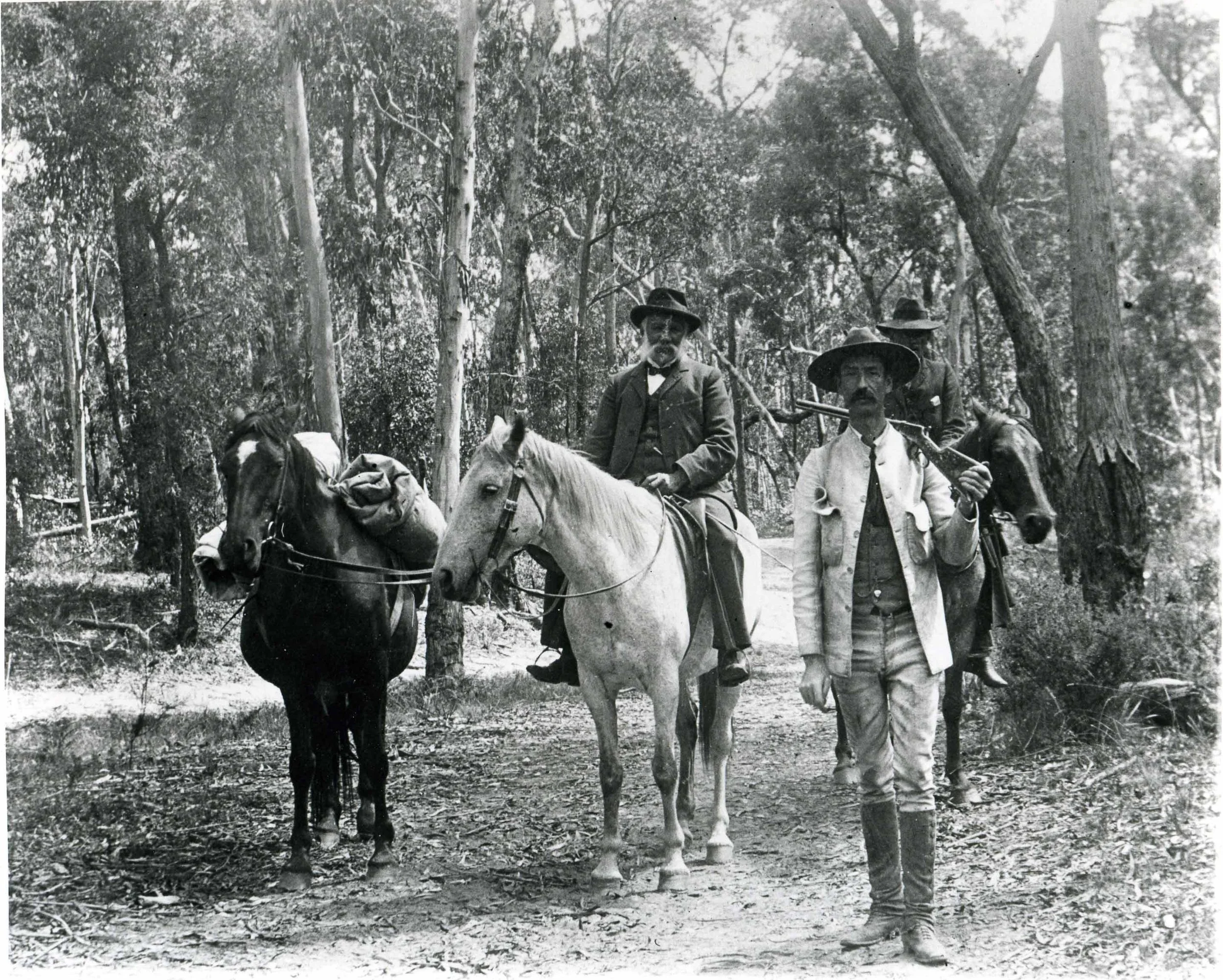
Walter Henry Bone, journalist and hunting guide, in Megalong Valley 1920s, from Blue Moutains Local Studies. (Blue Moutains City Library)
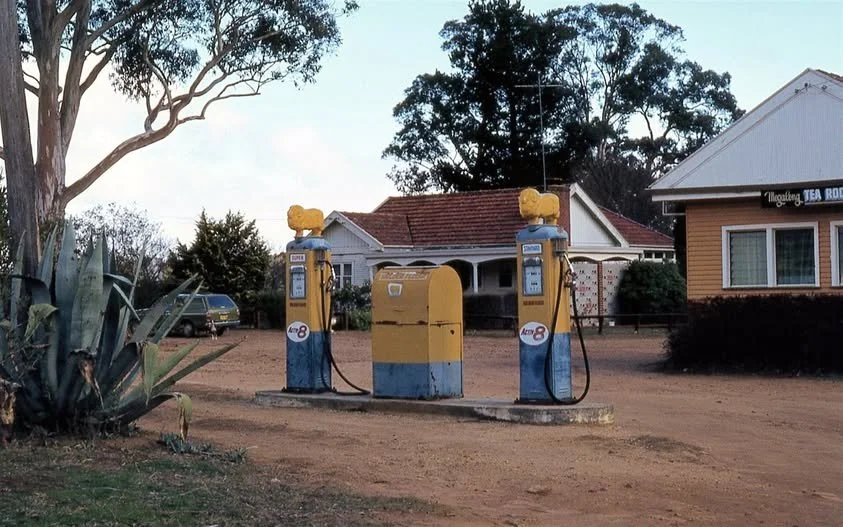
The famous Megalong Valley Tea Rooms, 1960s. (Christine Bundy)
Megalong Hospitality.
The twentieth century, with the arrival of wheeled access between Megalong and Blackheath and the increasing popularity of the automobile brought a new phenomenon to Megalong - tourism. In the 1920s and 1930s there were three and four teahouses to entertain visitors to the Valley, and guesthouses to accommodate them. By the 1950s only one teahouse remained in Megalong, that of Thelma Duncan, which we still enjoy today. After the war ownership of motor cars became so widespread that many people (from Sydney) could now easily travel to areas beyond the Blue Mountains, and beyond Megalong Valley, to enjoy their recreation.
Ease of travel between valley and city in recent decades has introduced the concept of weekend residents to Megalong; those who work and reside in Sydney during the week but chose to join our rural community and spend their downtime profitably in the Valley. In terms of demography Megalong Valley today comprises fewer permanent residents than in previous times.
Recent additions to Megalong, as the village transitions beyond the millennium, has been the introduction of a strong grape culture, a micro wine industry. Started at the turn-of-the-century by two re-settled families from Sydney, relying initially on local volunteer labour to tend the vines, and a third Hunter Valley and French-trained oenologist, the Valley today proudly boasts two vineyards, and three wine producers. These initiatives have latterly been joined by a highly-regarded a la carte restaurant and Australia’s premium stud for Icelandic Horses Megalong’s enterprises have generated significant public interest, along with accompanying tourist traffic, in the valley; which in turn has created a strong measure of local employment.
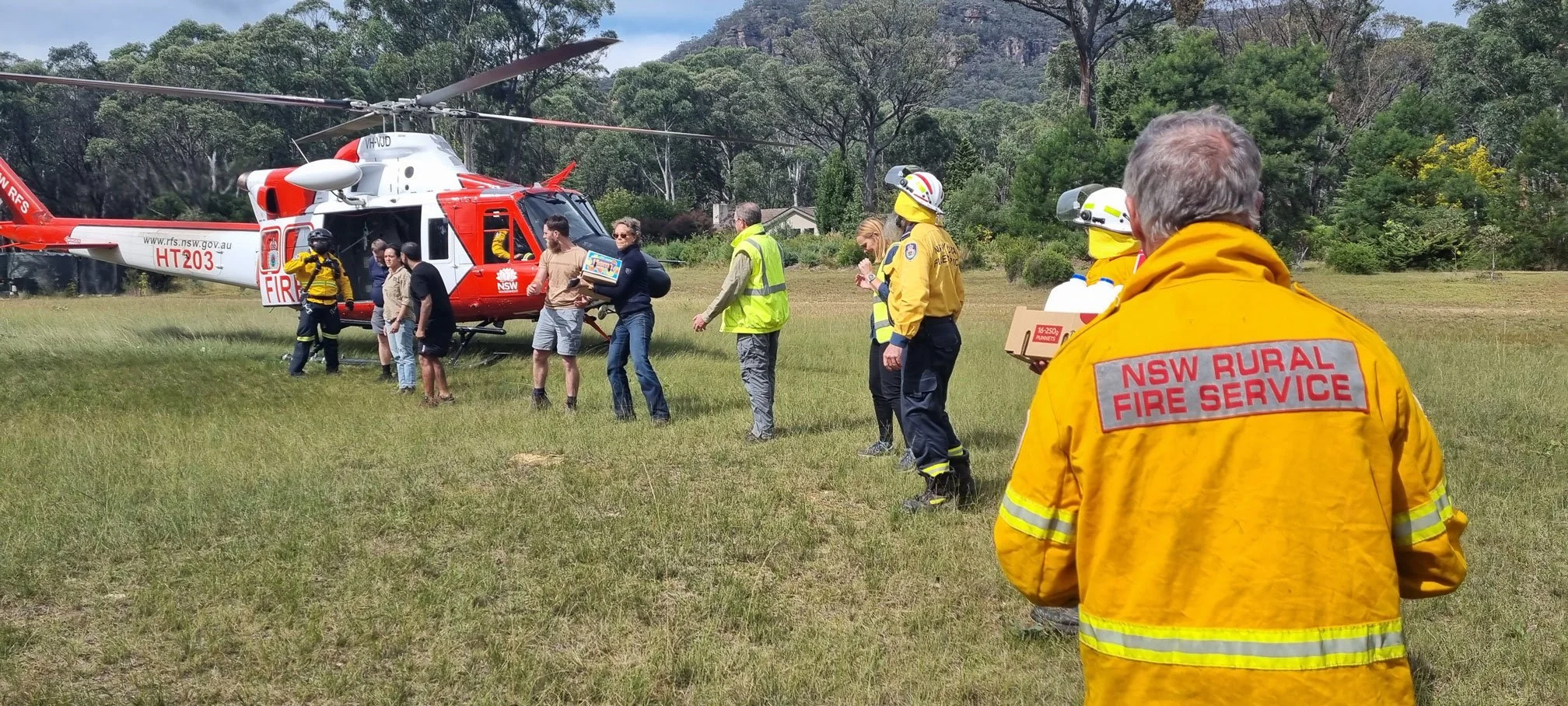
Emergency air drops, 2024. Photo by Simon Anderson.
Community Resilience.
The only recent deviation from the continued passage of progress for Megalong Valley and its residents has been a season or two of unprecedented aberrant weather, with accompanying physical damage. Christmas 2019 brought with it significant bushfires - conforming to a random pattern in the Valley’s history. These were challenged, and stared down, by the heroic efforts of our own volunteer bush fire brigade, with support from several brigades from along the mountain ridge, and from Sydney. Three months later, March 2020, saw the start of several years of extreme rainfall events.
2022 was Megalong’s wettest year ever, reaching that point within nine months, on 6th October 2022, resulting in five sets of temporary traffic lights between Megalong and Shipley. A further landslip in April 2024 saw the road connected by an escort vehicle for 12-months. These challenging events have drawn the community together, strengthening group resolve to face adversity together - including, on one memorable occasion, a Street Party on Chaplowe Hill.
As Megalong Valley contemplates pushing forward into the third century of its being, and weather permitting, there is now every reason to be confident that the future of our small community - economic, lifestyle, peace - is secure.
Further Reading.
Mary Shaw’s Historic Megalong Valley
1988
Keith Duncan’s The Duncans of “Ballymore”
1923